2 minutes
Summer Undergraduate Research: Evan Li and Julie Scherzer
Last week, two undergraduate researchers in our group, Evan Li and Julie Scherzer, completed their summer research experiences and presented their work at The Ohio State University. Their projects used ultra-peripheral heavy-ion collisions—encounters in which fast-moving nuclei pass close enough for their electromagnetic fields to interact without a direct nuclear collision—to investigate the structure of atomic nuclei.
Evan participated through the Ohio 5-OSU Summer Undergraduate Research Experience, while Julie conducted her project through the Physics Summer Research Program and presented at the Undergraduate Research Symposium.
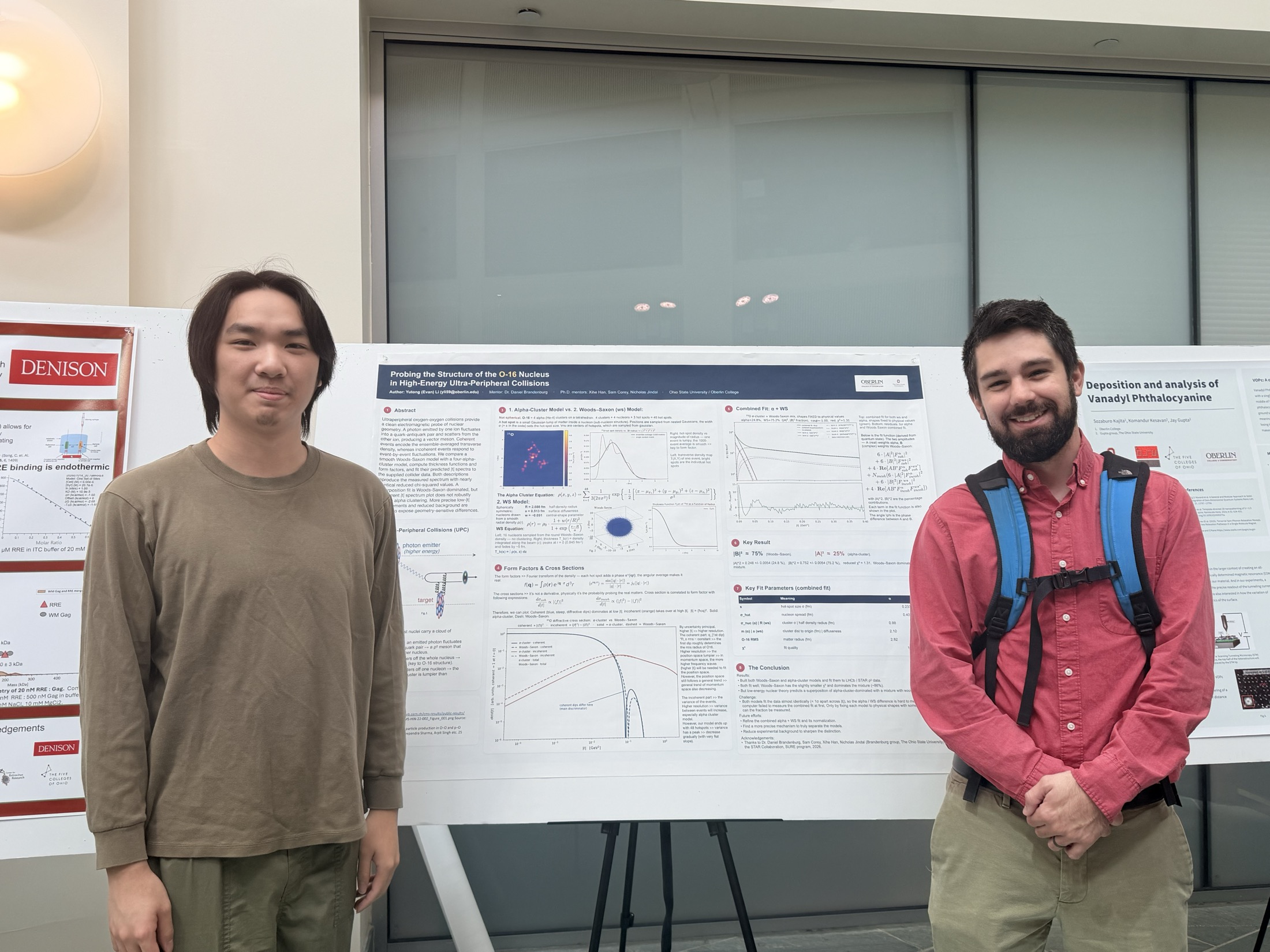
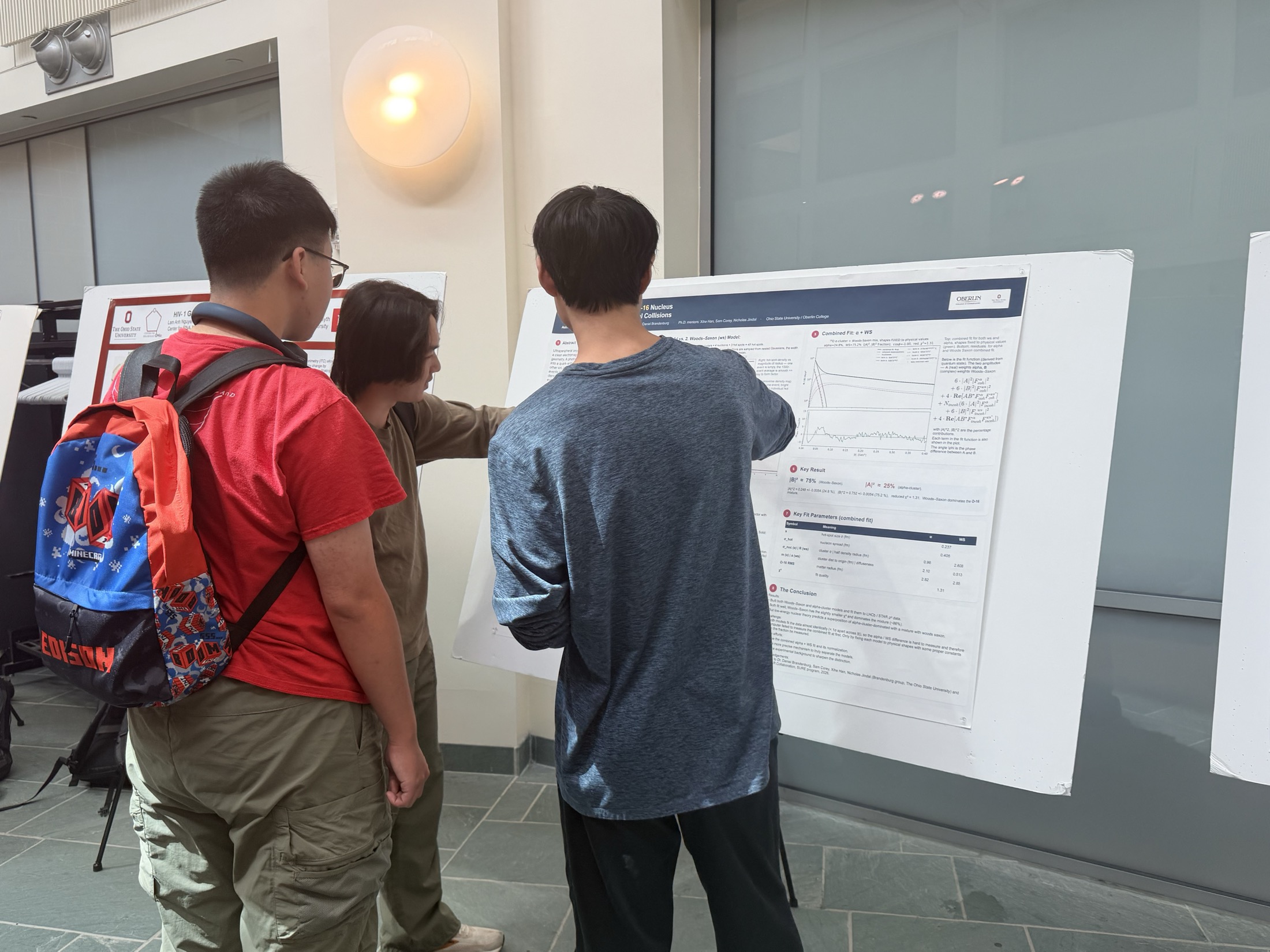
Evan Li: probing oxygen-16 structure
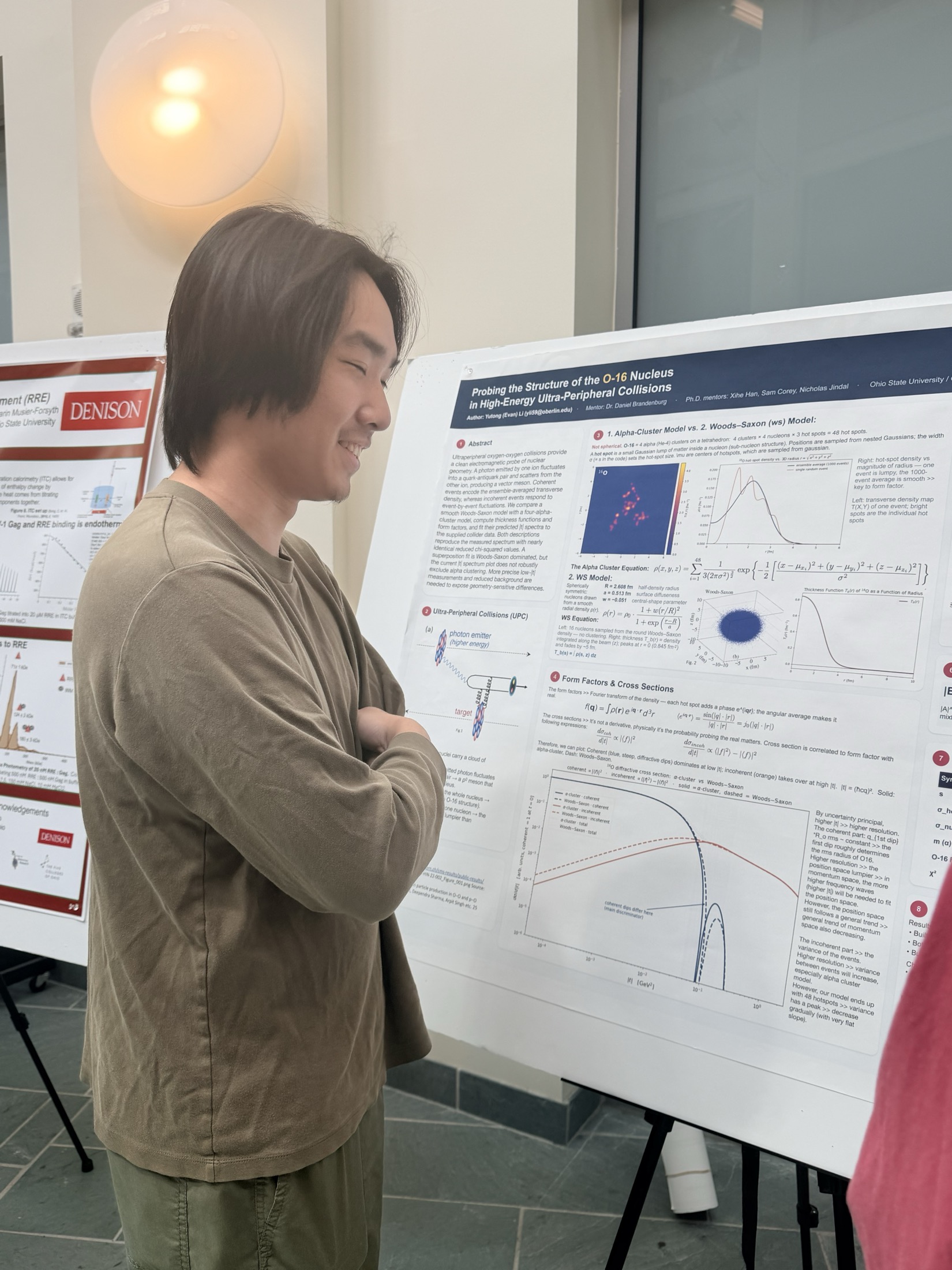
Evan's project, “Probing the Structure of the O-16 Nucleus in High-Energy Ultra-Peripheral Collisions,” compared two pictures of the oxygen-16 nucleus: a smooth, spherical Woods–Saxon distribution and a model in which the nucleus is built from four alpha-particle clusters. The distinction matters because the spatial structure of a nucleus leaves an imprint on the particles produced in high-energy collisions.
Using simulated nuclear density distributions, thickness functions, and form factors, Evan fit the predicted momentum-transfer spectra to collider data. Both descriptions reproduced the measured spectrum well. In a combined fit, the Woods–Saxon contribution dominated, while an alpha-cluster component remained compatible with the data. Evan's work highlights both the promise and the challenge of these measurements: resolving geometry-sensitive differences will require more precise low-momentum-transfer data and reduced experimental backgrounds.
Julie Scherzer: photonuclear measurements with asymmetric ions
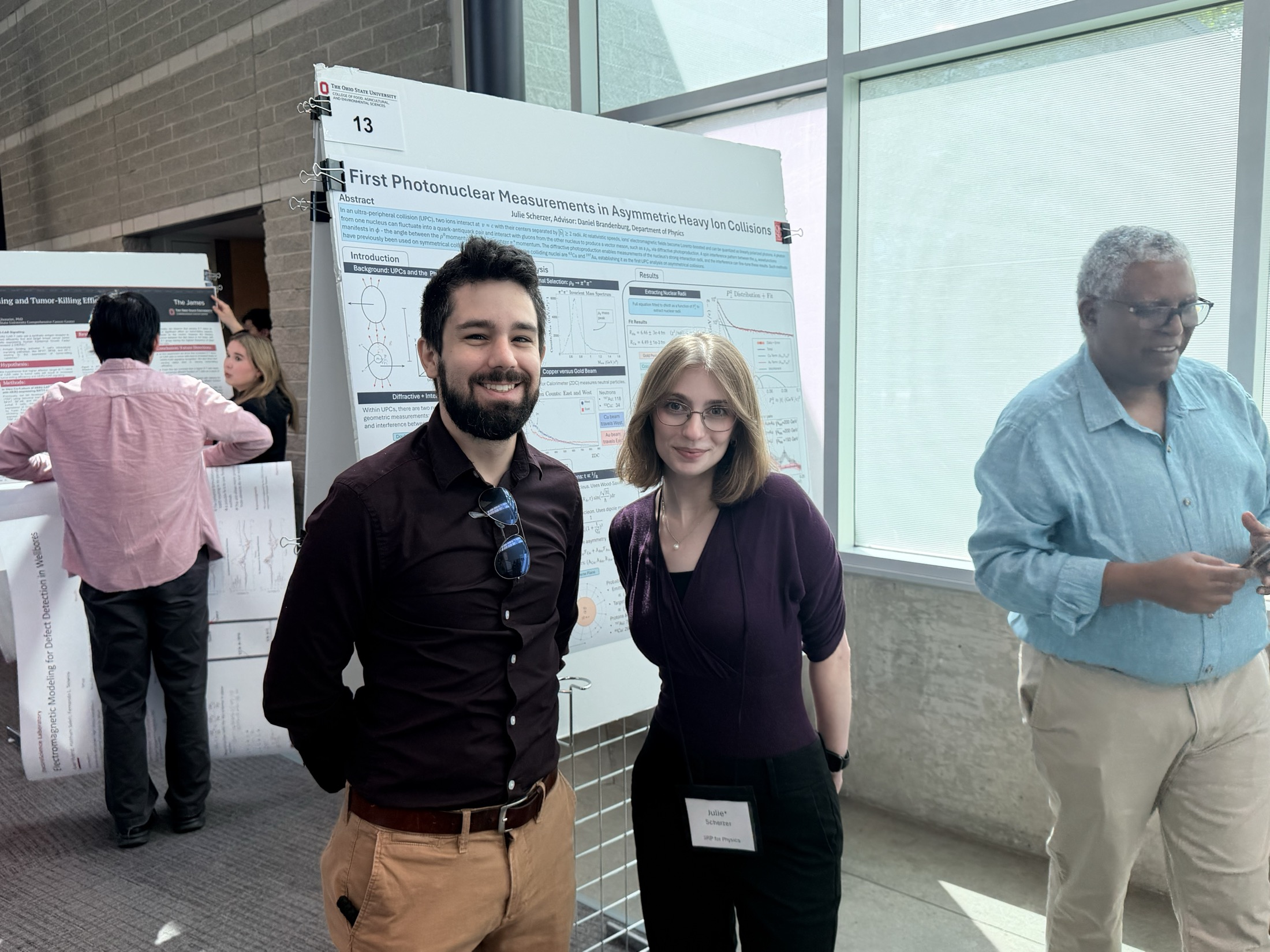
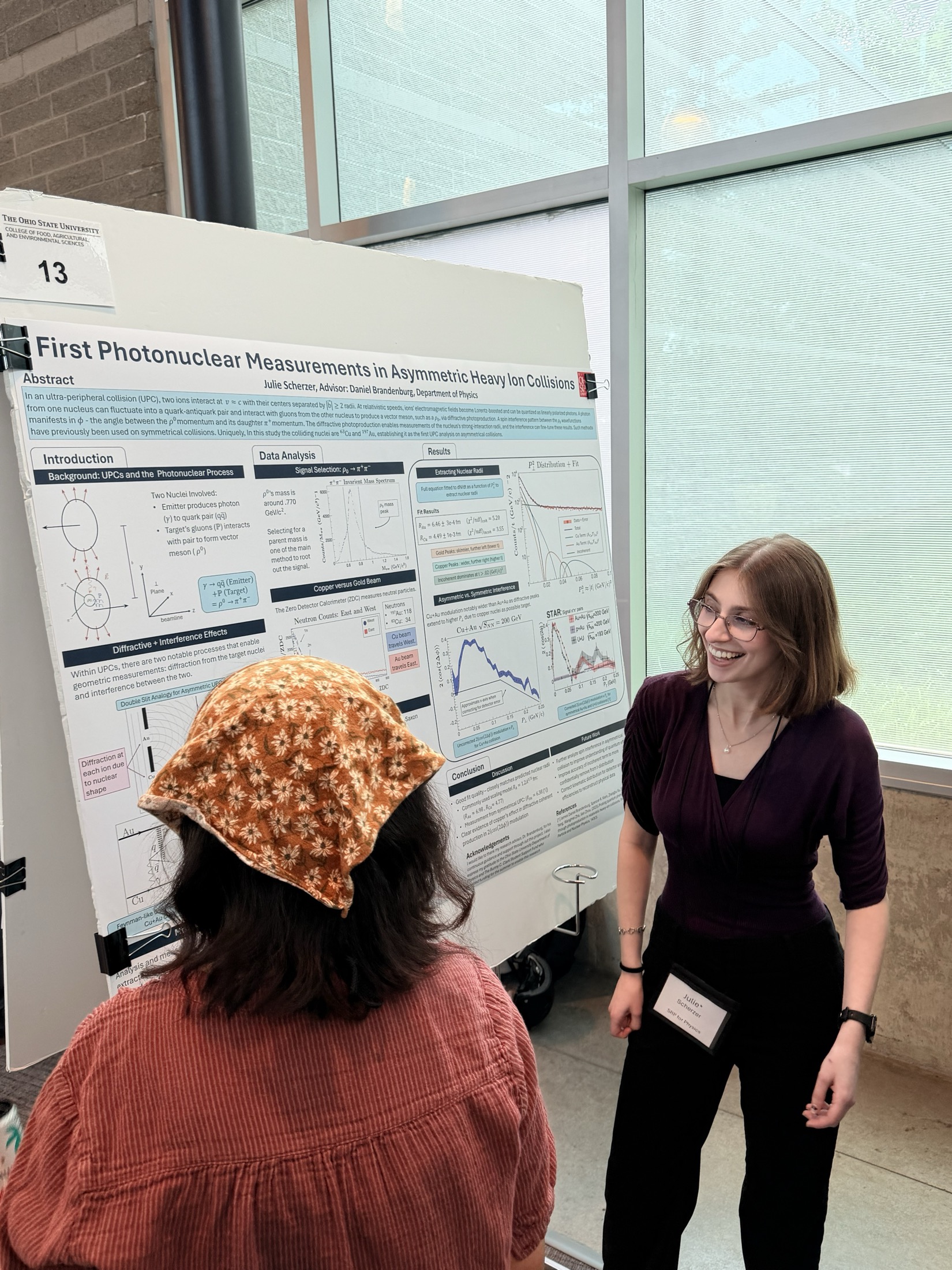
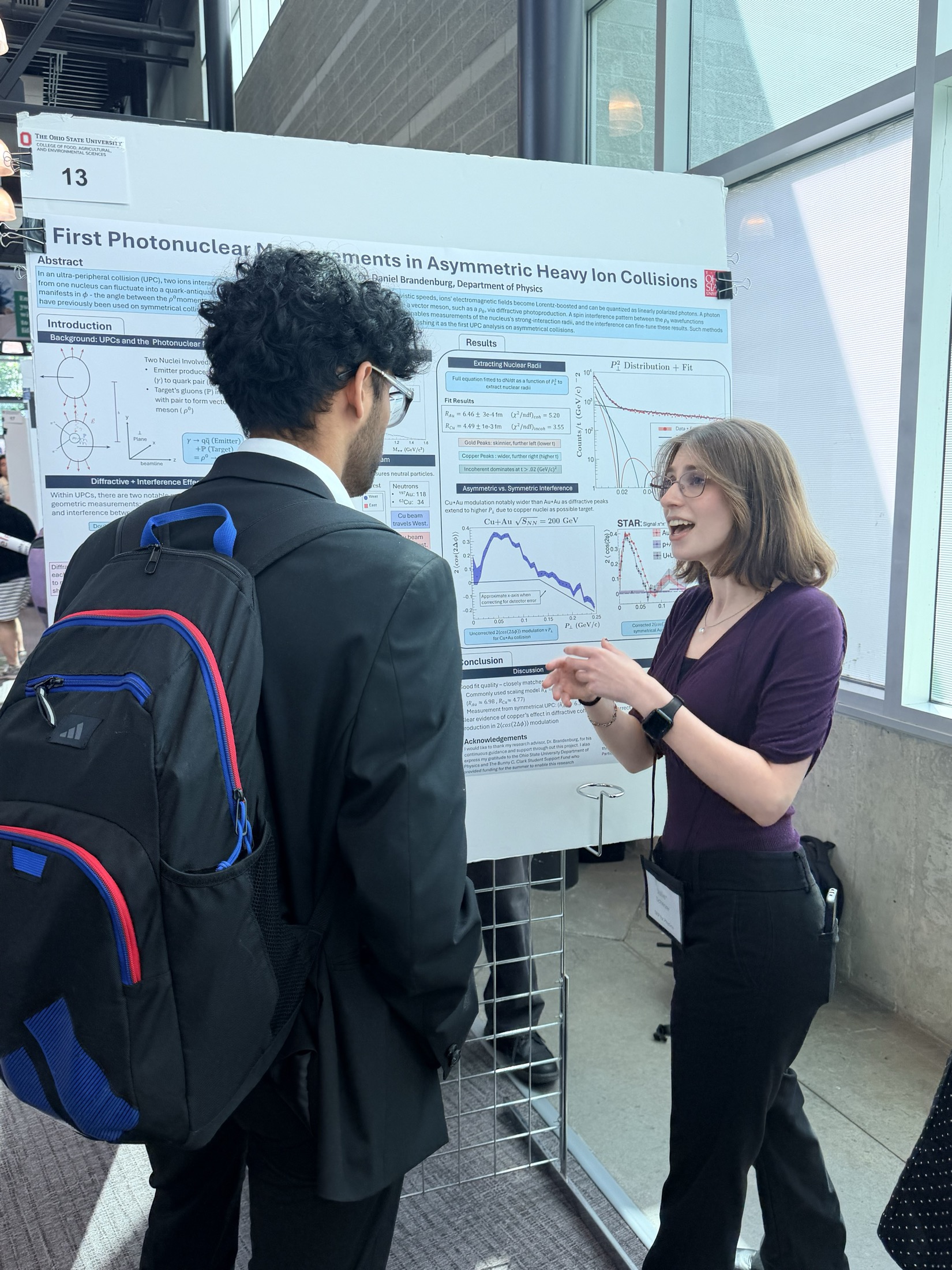
Julie's project, “First Photonuclear Measurements in Asymmetric Heavy Ion Collisions,” studied photonuclear processes in collisions between copper and gold nuclei. In an ultra-peripheral collision, the intense electromagnetic field of one ion can act as a beam of photons. These photons can produce vector mesons through interactions with the other nucleus, creating a powerful probe of nuclear size, shape, and quantum interference.
Julie analyzed copper–gold collisions at a center-of-mass energy of 200 GeV per nucleon pair. By reconstructing rho mesons and studying the momentum-transfer distribution, she extracted nuclear-radius information and examined interference patterns that are sensitive to the asymmetric collision geometry. Her results show clear effects associated with the copper nucleus in the diffractive component of the data and establish a foundation for the first ultra-peripheral-collision analysis with asymmetric ions.
Congratulations to Evan and Julie on an excellent summer of research and on sharing their results with the broader Ohio State community. I am grateful to the graduate-student mentors and collaborators who supported their work, including Xihe Han, Sam Corey, and Nicholas Jindal.